

Most advice about optimizing for AI search is either too vague to act on or too technical for the person who owns the website. “Write great content” is not a plan.
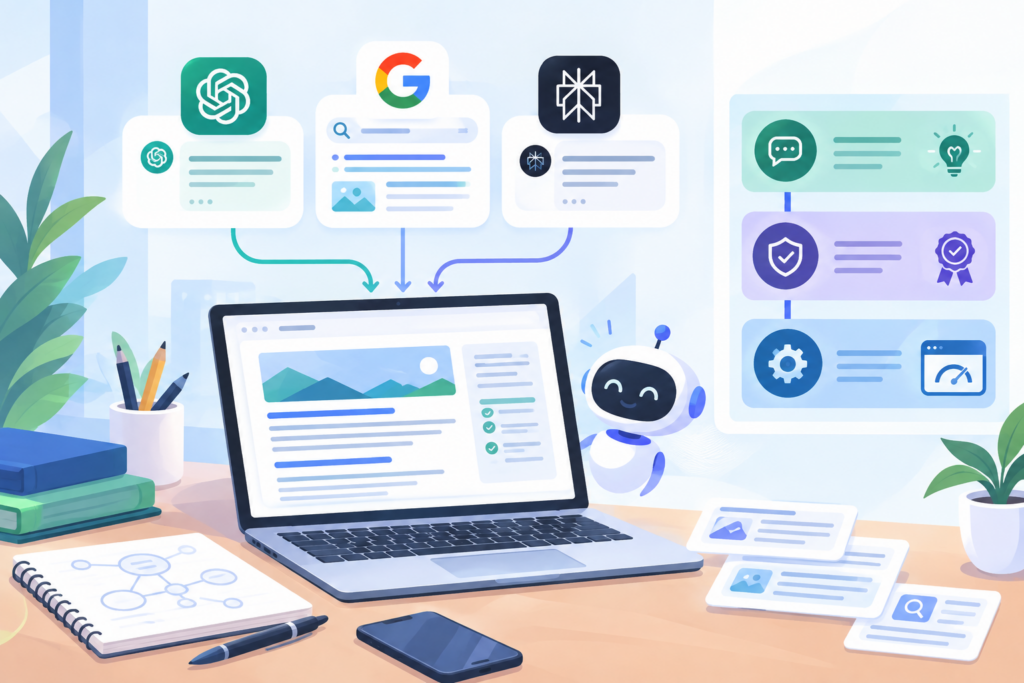
Our content team rewrites client pages for this every week, and the work sorts into eight elements across three layers: what you say, why the AI should believe you, and how your site delivers it.
So here is the framework we use when we rework pages for AI visibility.
Build pages around questions, not keywords. AI search is conversational. Nobody types “kitchen remodel cost Chicago” into ChatGPT. They ask “how much should I expect to pay to redo a kitchen in Lincoln Park?” Your front desk hears these every week. Write them down. Better research than any keyword tool.
Answer in the first sentence. When a heading poses a question, the next sentence answers it. Not the third paragraph. AI tools extract short, self-contained answers and skip pages that make them dig. A Chicago family law firm explaining property division should open with the rule: Illinois is an equitable distribution state, meaning marital property is divided fairly rather than split down the middle. Then explain what that means in practice.
This is the most common fix we make. The expertise is usually already on the page, buried four paragraphs deep under a warm-up nobody reads.
Make your entity unmistakable. AI tools will not recommend a business they cannot confidently identify. Your name, location, services, and service area must read identically on your site, your Google Business Profile, and every directory listing. “Serving Chicagoland” is vague. “Serving the North Shore from Evanston to Highland Park” is something a machine can use.
Back claims with specifics. Specifics get cited; generalities get skipped. Replace “fast turnaround” with the actual timeline and what happens at each stage. Reference what can be verified: Chicago permit requirements, Cook County filing deadlines, published industry data. Original information carries the most weight, because no competing page can offer it.
Put a name on it. Author expertise is among the clearest trust signals these tools evaluate. Attach content to a real person with a bio and credentials. A page on commercial lease negotiation bylined by a named Chicago real estate attorney carries weight the same page published anonymously never will.
We see this constantly with the trades. An electrician who has pulled permits here for twenty years has more authority on Chicago code than any content mill, and no way for a machine to know it unless his name and license are on the page.
Add structured data. Schema markup states outright what your content is: an organization, a local business, an article with a named author. Google uses it to interpret pages, and its AI features are built on that interpretation. At minimum, implement Organization or LocalBusiness schema, plus Article schema with author details on your blog.
Link with intent. Internal links show how your topics connect. An HVAC company with a furnace hub page linking out to repair, replacement, and maintenance, each linking back, signals genuine depth. Orphan pages read as afterthoughts to crawlers and AI tools alike.
Keep it current. Perplexity favors recent content, and stale information hurts everywhere. Review core pages twice a year and update pricing, regulations, and statistics. A page still quoting 2022 rates tells every AI tool that nobody is minding the store.

We do this work across more than 350 cities, which makes the Chicago pattern easy to see.
In thinner markets, a templated location page still ranks. Here it does not. Too many competitors run the same play: the kind of page where only the city name changes between Wicker Park and Schaumburg, and AI tools have nothing to choose between. Real neighborhood detail is the differentiator, and it is why SEO services in Chicago cannot run off a national template.
You do not need to rebuild the site. Take your five highest-value pages and work through them in order.
Rewrite the headings as questions customers ask. Move the direct answer into the first sentence under each. Add a named author with a short bio. Implement schema matching the page type. Link the five to each other and to a hub. Then set a reminder to review each in six months. That last step is Recalibrate, and skipping it is how good pages quietly go stale.
That is ChatGPT SEO optimization in its least glamorous and most effective form. No tricks, no gaming, just pages built to be understood.
We have worked as an SEO agency in Chicago since 2008, and one pattern holds across every industry we write for, from personal injury firms to suburban HVAC contractors: when a page makes the machine’s job easy, the machine rewards it. If you want a second opinion on which five pages to start with, our audit is free.

332 S Michigan Ave, Chicago,
IL 60604
11516 183rd Pl Unit NE
Orland Park, IL 60467


We are Dabaran, a Chicago-based SEO firm boasting over a decade of experience in the field.
© Copyright 2026 Dabaran Inc. All Rights Reserved. HTML Sitemap Privacy policy
Programs provi patient peace mind when option.

